
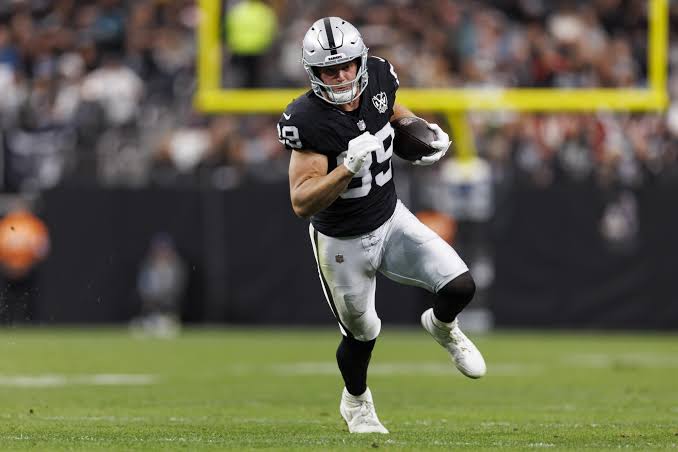
Tight end remains the most top-heavy position in fantasy, and the gap between the true difference-makers and everyone else is as wide as ever heading into 2026. What makes this year different is the sophomore class — Colston Loveland, Tyler Warren, and Harold Fannin Jr. all busted out as rookies and now enter the season as legitimate top-10 options. Add in a genuine changing of the guard at the very top and a handful of contract-year and opportunity-driven names, and this year’s board is as fascinating as it’s been in years. Here’s the top 20.
1. Brock Bowers, Las Vegas Raiders
Bowers has averaged at least 14.5 receiving points per game in each of his two NFL seasons despite the Raiders posting one of the league’s worst team passing grades over that span — a feat no other high-volume tight end has managed with that little quarterback support. He broke the rookie receptions record in 2024 and was the TE2 in points per game last year even through an early-season injury and rough quarterback play. With better quarterback options in the building and no true No. 1 receiver to compete with for targets, a 150-plus target season, and a run at Trey McBride’s single-season receptions record, are both squarely in play.
2. Trey McBride, Arizona Cardinals
McBride wore the TE1 crown in 2025, and with no tight end repeating as the position’s top scorer in consecutive years since Travis Kelce’s 2018-2020 run, there’s a real argument this spot is up for grabs. Still, McBride’s target volume and role as Arizona’s clear top weapon make him a virtual lock for elite production again.
3. Colston Loveland, Chicago Bears
Loveland struggled early as a rookie due to injury and inconsistent play, then turned into an unstoppable force down the stretch — the TE2 in points per game over the final ten weeks of the season, trailing only McBride. A full offseason with Ben Johnson’s offense and a steadier Caleb Williams gives him a legitimate path to finishing as the position’s top scorer, which is why he’s become one of the position’s biggest helium picks this summer.
4. Tyler Warren, Indianapolis Colts
Warren led all Colts pass-catchers in targets as a rookie and finished as the TE5 despite a clear second-half fade tied to Daniel Jones’ late-season injury. Indianapolis leaned further into him this offseason, trading away Michael Pittman without adding any real pass-catching replacement, which funnels even more work Warren’s way. His rookie-year production (76 catches, 817 yards, four scores) looks like a reasonable floor with real room to grow.
5. Tucker Kraft, Green Bay Packers
Kraft was performing like the fantasy TE1 before an ACL tear last November ended his season, and recent reporting suggests real optimism that he’ll be ready for Week 1 — potentially without even missing camp time. If the recovery goes as expected, he re-enters the position’s true top tier.
6. Sam LaPorta, Detroit Lions
LaPorta has legitimate Tier 1 upside if he’s fully healthy, but he’s coming off back surgery for a herniated disc and is now two seasons removed from his Pro Bowl rookie year. The talent and offensive context are both still excellent — health is the only real question mark.
7. Kyle Pitts, Atlanta Falcons
Pitts closed last season with an 11-catch, 166-yard, three-touchdown eruption in Week 15 that reignited the long-dormant hype. The play-caller and quarterback context both support another leap, though his splits with and without Drake London on the field are worth watching closely.
8. Harold Fannin Jr., Cleveland Browns
The clearest opportunity boost of any tight end this offseason belongs to Fannin. David Njoku’s departure to the Chargers removes the only real obstacle to a full-time role, and Fannin’s five-game preview without Njoku last year produced nearly 16 PPR points per game. Cleveland’s depth chart behind him is thin, and new head coach Todd Monken has a track record of featuring tight ends heavily. The quarterback situation is the lingering question, but the sheer opportunity here is top-five if the targets materialize as expected.
9. George Kittle, San Francisco 49ers
Kittle tore his Achilles in San Francisco’s wild-card win in January, and that recovery timeline at age 32 is the shadow hanging over his draft price. When healthy, he remains one of the most dynamic receiving tight ends in football — but anyone drafting him should have a real handcuff plan in place.
10. Travis Kelce, Kansas City Chiefs
It’s easy to forget how good Kelce still was last year — a top-five tight end averaging over 13 points per game through Week 13, before Patrick Mahomes’ injury changed everything. A full, healthy season of Rashee Rice back in the mix could cap his target upside somewhat, but Kelce’s floor remains higher than his ADP would suggest.
11. Isaiah Likely, New York Giants
Likely signed a three-year, $40 million contract that vaults him into the five highest-paid tight ends in football, reuniting him with former Ravens assistant John Harbaugh in New York. He flashed real ceiling at times over four seasons in Baltimore but never fully broke out — the fresh start and clean depth chart make him one of the more popular breakout bets at the position, as long as the price paid isn’t a true TE1 price.
12. Mark Andrews, Baltimore Ravens
Andrews averaged at least 9.1 half-PPR points per game every year from 2019 through 2024, and with Isaiah Likely now gone to the Giants, he’s clearly Baltimore’s No. 1 tight end again. He’s TD-dependent and has been inconsistent the last couple seasons, but the volume and Lamar Jackson connection make him a reliable settle-for option in the middle rounds.
13. Dallas Goedert, Philadelphia Eagles
Goedert remains a productive, TD-dependent option on one of the league’s better offenses, and he lost some target competition this offseason that should help stabilize his role as a low-end starter.
14. Hunter Henry, New England Patriots
Henry has been a steady, reliable target earner without a huge ceiling, projecting as a fringe TE1 who can be found in the later rounds of most drafts.
15. T.J. Hockenson, Minnesota Vikings
Hockenson remains a talented, high-floor option when healthy, though he now competes with a deep group of pass-catchers for targets in Minnesota’s offense.
16. Dalton Kincaid, Buffalo Bills
Kincaid led all tight ends in yards per route run last year on just a 38% snap share while the Bills carefully managed a knee injury. Buffalo added DJ Moore to the receiving room, but Kincaid should still rank second on the team in targets behind him. If he can finally stay on the field for a full season, there’s more upside here than his current price reflects.
17. Chigoziem Okonkwo, Washington Commanders
Okonkwo signed a three-year, $30 million deal with Washington that gives him a much cleaner path to consistent playing time than he had in Tennessee, putting him firmly in the low-end starter conversation.
18. Jake Ferguson, Dallas Cowboys
Ferguson set career highs with 82 receptions and eight touchdowns last season and was the fantasy TE5 during Dak Prescott’s healthy stretches. He’s now third in the pecking order behind CeeDee Lamb and George Pickens, which caps his target share, but his knack for finding the end zone keeps him fantasy-relevant.
19. Brenton Strange, Jacksonville Jaguars
Strange projects as a solid streaming option capable of nine or ten points most weeks, offering a reasonably safe floor in an offense that should be more competent overall in 2026.
20. Juwan Johnson, New Orleans Saints
Johnson finished as last year’s TE10 but has seen his draft stock crater this offseason, going as low as TE26 in some early ADP charts. New Orleans’ passing game will lean on Chris Olave first, and the team spent an early pick on rookie receiver Jordyn Tyson, but Johnson’s proven production makes him a value worth watching in the later rounds.
The bigger picture
This year’s tight end class is defined by its top tier being both larger and younger than usual, with three second-year breakouts (Loveland, Warren, Fannin) pushing into true TE1 territory alongside the established names. That depth at the top makes the traditional “wait on tight end” strategy riskier than usual if you miss the first six or seven names, since the drop-off to streaming-caliber production arrives faster than at other positions. Health remains the swing factor for the group directly behind the top tier — Kraft, LaPorta, and Kittle are all one clean bill of health away from re-entering the true elite conversation.