
Draft season is at its peak this week, and the position that decides most leagues is the one carrying the least certainty. A long list of NFL offenses will open the season without a settled lead back, and drafters keep making the same mistake with them: they treat an unresolved job as a discount when it is usually a tax. Below are the five murkiest backfields in football, what the usage data actually says, and how to price each one. ADP figures come from FantasyFootballCalculator’s 12-team PPR sample of 7,830 mocks run between August 19 and August 26, 2026; statistics are 2025 regular season.
Pittsburgh: the depth chart and the practice field disagree
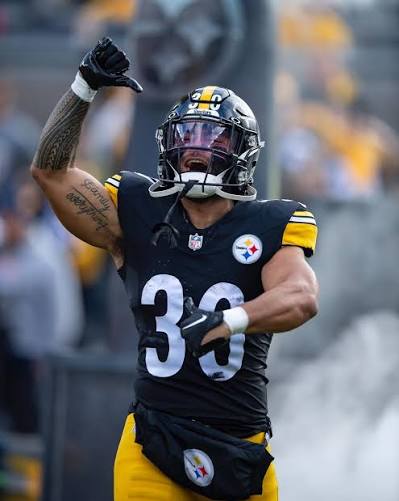
This is the most valuable unresolved job in football, and the evidence points in two directions at once. When the Steelers released their initial depth chart on August 5, Jaylen Warren was listed ahead of free-agent addition Rico Dowdle, with Kaleb Johnson third. Four days earlier, beat reporters at camp had Dowdle taking the first snap with the first-team offense in nearly every seven-on-seven and eleven-on-eleven period under new head coach Mike McCarthy.
The production argues for a split. Warren cleared 200 carries for the first time in 2025, finishing with 211 attempts for 958 yards and six scores, plus 40 catches for 333 yards and two more — 1,291 yards from scrimmage and an RB17 finish in PPR. Dowdle, in Carolina, out-carried him: 236 attempts, 1,076 yards at 4.6 per pop, six touchdowns, 39 receptions, 1,373 total yards.
The tiebreaker is receiving work. Kenneth Gainwell caught 73 passes for 486 yards out of this backfield last season and is now in Tampa Bay. Someone absorbs those targets, and Dowdle has never topped 39 catches in a season. That is why the market has Warren at 58.4 overall and Dowdle at 74.3, and why the gap is correct even if Dowdle wins the early-down job.
How to draft it: Warren is the pick if you need floor. Dowdle at 74 is strong contingent value — priced as a committee back, bell cow if Warren misses time. Do not take both.
New England: the market finally split the difference
Every depth chart projection in circulation lists Rhamondre Stevenson as the starter and TreVeyon Henderson as the backup. Every touch count from last season says the opposite already happened. Henderson led the Patriots with 215 touches, 1,132 scrimmage yards and 10 total touchdowns as a rookie, running 180 times for 911 yards at 5.1 per carry with nine scores and adding 35 catches. Stevenson played 14 games and finished with 130 carries for 603 yards and 32 receptions.
Snap share tells a third version: Stevenson was near 60 percent, Henderson around 46. And Stevenson closed strong — 5.7 yards per rush on 87 carries over his final eight games including the playoffs, second among all backs in that window, with a 26.4 percent forced missed tackle rate that ranked sixth. ADP has landed almost exactly on the ambiguity: Henderson 62.1, Stevenson 65.1. That is an honest price for a coin flip, which is why neither is a bargain.
How to draft it: If you are taking one, take Henderson — the explosive-run profile and the touchdown equity are the harder things to replace, and he already won the touch battle once. If both are on the board in the sixth, the correct move is usually to take neither and get a back with a clear job.
Denver: a three-man room and one pinky promise
J.K. Dobbins was excellent when available last season: 153 carries for 772 yards at 5.0 per attempt in 10 games. The parenthetical is the whole investment thesis. Asked about his availability on July 31, Dobbins said, I will be there all 17 games, I’ll pinky promise you all here right now. He then had a soft-tissue scare in practice on August 11 and was back on the field the next day.
RJ Harvey makes the room three-deep and hard to price. Harvey ran 146 times for just 540 yards — a weak 3.7 per carry — but caught 47 passes for 356 yards and scored 12 total touchdowns. That is a specialist’s line: receiving and red-zone work, not a between-the-tackles replacement. Rookie Jonah Coleman, going at 151.1, is the better fit as the actual handcuff.
How to draft it: Dobbins at 87.2 is fine value as the only true early-down runner there. Harvey at 89.7 is the trap — his finish was carried by touchdown volume unlikely to repeat at that efficiency. If you draft Dobbins, spend the late pick on Coleman.
Washington: the cheapest volume on the board
The most underpriced situation here belongs to Jacory Croskey-Merritt, who as a rookie ran 175 times for 805 yards at 4.6 a carry with eight touchdowns — and caught just nine passes for 68 yards. That last number is the ceiling problem, and it is the reason Rachaad White is on the roster. White handled 132 carries for 572 yards and 40 receptions in Tampa last year and profiles as the pure passing-down piece in coordinator David Blough’s offense. Rookie Kaytron Allen, Penn State’s all-time leading rusher, is the short-yardage candidate.
That three-way split is why both are cheap: White at 112.2, Croskey-Merritt at 115.1.
How to draft it: Croskey-Merritt is a legitimate tenth-round value because he already produced 800 rushing yards with no receiving role. In half-PPR and standard he is the clear preference; in full PPR, White is the steadier weekly play. This is one of the few rooms where doubling up costs almost nothing.
Minnesota: the split is the plan
Most murky backfields get resolved by a coach. Minnesota’s may not. As of August 20, Aaron Jones was still the listed starter, with the staff planning something close to a 50-50 rushing split with Jordan Mason. Both took exactly three carries in the preseason opener.
The efficiency case belongs to Mason. Across the 12 games the two shared last season, Jones averaged 11.0 carries at 4.2 yards per attempt while Mason averaged 6.2 at 4.8. Jones finished with 132 carries for 548 yards and 28 catches; Mason ran 159 times for 758 yards and six scores. Kevin O’Connell has praised Mason’s conditioning this summer, saying he’s in unbelievable shape right now, and Mason is 27 to Jones’s 31.
How to draft it: Jones at 103.1 costs more than Mason at 117.0 for the worse per-carry profile and the older body. Mason is the better bet at the cheaper price, and he is the one who inherits the room if the split ever tilts.
Three more rooms worth a second look
- Los Angeles Rams. This is not actually murky — Kyren Williams ran 259 times for 1,252 yards and 10 touchdowns and goes at 31.6. But Blake Corum’s 145 carries for 746 yards at 5.1 per attempt is the best backup line in the league, and he is available at 122.2. That is the single best price-to-role handcuff on the board.
- Tampa Bay. Bucky Irving is going at 44.7 after a 10-game season in which he averaged just 3.4 yards per carry. The arrival of Gainwell, who caught 73 passes last year, meaningfully caps Irving’s receiving upside. Treat that ADP as a full price, not a discount.
- Jacksonville. Bhayshul Tuten at 52.1 is being drafted for the job rather than the resume. Travis Etienne’s vacated 260 carries and 1,107 rushing yards are real and available, but Tuten has never carried a full NFL workload. That is a bet on opportunity, and it should be sized like one.
How to price ambiguity
Three rules hold across all of these rooms. Receiving work is the most stable input in a split backfield — early-down carries move week to week, targets rarely do. An official depth chart released in early August is a weaker signal than snap share from the previous December, and New England is the clearest example. And the value in a committee is almost never the higher-ADP back; it is the cheaper one whose price already assumes he loses. Corum at 122, Croskey-Merritt at 115 and Mason at 117 are all priced as losers of competitions they may well win.
Roster cuts land on August 30 and a few of these rooms will read differently once the 53-man lists are official. Until then, draft the ones where the cheap back has an independent path to touches, and let someone else pay the committee tax.