
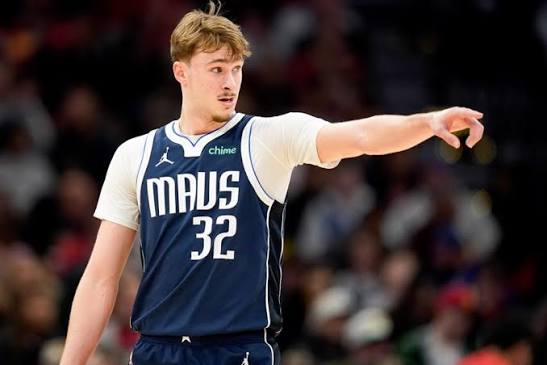
Training camps are open across the league, and the players drawing the most fantasy attention are not this year’s rookies. They are last year’s. The 2025 draft class produced the tightest Rookie of the Year race in over two decades and put multiple first-year players on the All-Rookie First Team, and now every one of them walks into camp with a real role instead of a projection. Here is how the top sophomores from that class stack up as fantasy assets heading into 2026-27.
The race that set the tone
Cooper Flagg beat Hornets wing Kon Knueppel for Rookie of the Year by a 26-point margin, the second-smallest gap since the award adopted its current voting format in 2002-03. That closeness matters for fantasy purposes: it means the runner-up in that race enters his second season with a legitimately bigger opportunity than most Rookie of the Year runners-up get, and the roster context around him has changed since the vote was cast.
1. Cooper Flagg, Mavericks
Flagg averaged 21.0 points, 6.7 rebounds and 4.5 assists on 46.8 percent shooting across 70 games as a rookie, leading Dallas in points, rebounds, assists and steals, a feat only Michael Jordan had matched since steals became an official stat in 1973-74. He is entrenched as Dallas’ offensive hub, and there is no real path to a smaller role in year two. The swing skill to watch is his 29.5 percent clip from three; even a modest bump there pushes him toward first-round fantasy value across most scoring formats.
2. Kon Knueppel, Hornets
Knueppel set the all-time rookie record with 273 three-pointers made while shooting 47.5 percent from the field, 42.5 percent from deep and 86.3 percent from the line, numbers efficient enough that his counting stats undersold him. Charlotte then traded LaMelo Ball to Minnesota in a four-team deal this offseason, handing primary ball-handling responsibility to Knueppel and Brandon Miller instead of funneling the offense through Ball. That usage bump is real, not projected, and it is why fantasy analysts are pushing Knueppel into fourth-round draft territory after he went in the middle rounds a year ago. He is the safest bet in this class to jump multiple rounds.
3. Dylan Harper, Spurs
Harper played a reserve role for most of his rookie year but still produced per-36-minute averages of 18.8 points, 6.1 assists and 5.4 rebounds across 69 games, well ahead of his 22.6 minutes per night. San Antonio’s frontcourt runs through Victor Wembanyama, but there is no proven answer at point guard ahead of Harper, and his per-minute efficiency argues for a real jump in playing time. Treat him as a value pick anywhere he is going based on last year’s role rather than this year’s opportunity.
4. VJ Edgecombe, 76ers
Edgecombe was the best two-way rookie in this class, averaging 16.0 points, 5.6 rebounds, 4.2 assists and a rookie-best 1.4 steals en route to All-Rookie First Team honors and a third-place Rookie of the Year finish. Philadelphia now runs him alongside LeBron James and Jaylen Brown under Nick Nurse, which should mean better spacing and fewer possessions where Edgecombe has to create offense from scratch. The steal totals alone make him a strong source of a category that is genuinely scarce in fantasy basketball, and better efficiency is the likeliest outcome of an improved supporting cast.
5. Ace Bailey, Jazz
Bailey’s full-season line, 13.8 points and 4.2 rebounds across 72 games, understates what he actually became. Over his final 23 games after the All-Star break, he averaged 18.3 points, 4.9 rebounds and 2.0 assists while his combined steals and blocks per game nearly doubled, and he strung together three straight 25-point outings in March. Utah has no reason to slow that role down, and current fantasy draft guides have him going in the sixth or seventh round, a range built on his season-long average rather than his finishing kick. If his second-half version is closer to his true talent level, he is being drafted a round or two too late.
What this means on draft day
The pattern across all five profiles is the same: real per-minute or per-possession production from last season, combined with a genuine change in opportunity heading into this one, whether that is a vacated backcourt in Charlotte, an open point guard job in San Antonio or simply a full offseason to build on a hot finish in Utah. Fantasy drafters chasing name recognition from last year’s rookie class will be bidding on ceiling that has already been priced in. The better plays are Knueppel and Bailey, whose situations improved more than their draft stock has, while Flagg remains the correct first-round anchor and Harper and Edgecombe are the buy-before-the-market-catches-up targets in the middle rounds.
The category-versus-points distinction matters here too. In points leagues, Flagg and Knueppel are the two building blocks of this group because scoring volume and efficiency both project up. In category formats, Edgecombe and Bailey carry extra weight for their steal and stock production, the kind of counting stat that is hard to find once the top two rounds are gone. Harper is the one profile that helps either format equally, since a bigger role simply scales everything he already does well. None of this is settled until preseason minutes and rotations firm up, but the direction for all five is the same: up, not down.