
There are two tight ends worth a premium pick in 2026, and then there is a twenty-round argument about nothing. Draft boards have not caught up to that, and the gap between what the position actually produces and what the market charges for it is the single most exploitable inefficiency on your cheat sheet this August.
The evidence is not subtle. FantasyPros’ latest consensus update found that tight ends occupy eight of the fifteen biggest overdraft gaps in the entire player pool — the widest spreads between where the public is drafting a player and where expert consensus says he belongs. Eight of fifteen, at one position, out of five. That is not noise. That is a market failure.
The Two-Man Tier Is Real
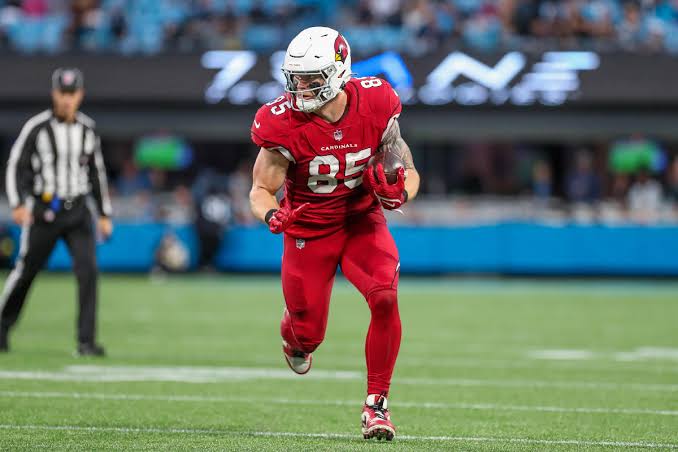
Start with why the top of the position deserves its price. Trey McBride did not just win the position in 2025 — he broke it. The Cardinals tight end caught 126 passes on 169 targets for 1,239 yards and 11 touchdowns across 17 games, a reception total that set an NFL single-season record at the position and earned him first-team All-Pro honors. In PPR he averaged 18.6 points per game and finished with 315.9 total points, outscoring the next-closest tight end by nearly 90 points.
Ninety points is not a tiebreaker. Ninety points is roughly six full games of production that every other roster in your league had to find somewhere else. That is what a genuine positional advantage looks like, and it is why McBride going at 30.2 overall in 14-team PPR mocks is defensible rather than reckless.
Brock Bowers is the other one, and his case is a health case. As a rookie in 2024 he posted 112 catches for 1,194 yards on 153 targets, good for 15.5 PPR points per game. A Week 1 knee injury wrecked 2025 — he played 12 games, landed on injured reserve, and finished with 64 catches for 680 yards and seven scores. But look at the rate: 14.7 PPR points per game, barely off his rookie pace, while playing hurt. His current ADP of 36.8 is buying a two-year sample of elite per-game production at a discount created entirely by games missed.
Why the Regression Case on McBride Is Overstated
You will hear that McBride’s 11 touchdowns are unsustainable, and there is something to it — he scored twice on 111 catches in 2024. But touchdown regression cuts a specific way here. His receptions and yardage were built on a 169-target workload that has been stable and growing for three years. Even if the touchdowns halve, a 120-catch, 1,200-yard baseline still clears the field. The volume is the asset; the touchdowns were the bonus.
Then the Floor Falls Out
Here is the part your draft room is mispricing. Behind Bowers, the 2026 tight end board looks like this in 14-team PPR average draft position, drawn from more than 6,800 mock drafts run between August 11 and August 18:
- TE3 Colston Loveland (Bears) — 57.0 overall
- TE4 Tyler Warren (Colts) — 64.2
- TE5 Kyle Pitts Sr. (Falcons) — 77.2
- TE6 Harold Fannin Jr. (Browns) — 78.2
- TE7 Sam LaPorta (Lions) — 86.7
- TE8 Tucker Kraft (Packers) — 102.6
- TE9 Travis Kelce (Chiefs) — 107.7
- TE10 George Kittle (49ers) — 115.3
Now put last season’s actual production next to those prices. Loveland, the TE3 going in the fifth round, finished 2025 with 58 catches for 713 yards and six touchdowns on 82 targets — 10.3 PPR points per game. Warren, the TE4, made a Pro Bowl and caught 76 balls for 817 yards and four touchdowns on 112 targets. Fannin led the Browns in receiving as a rookie with 72 grabs for 731 yards and six scores, worth 11.7 PPR points per game.
Those are the same player. Not literally, but functionally: three young tight ends who all landed between roughly 10 and 12 PPR points per game on target shares in the 80–115 range. Yet the market charges a pick-and-a-half-round premium for Loveland over Fannin and a full round for Warren over Pitts. There is no production difference underneath those prices to justify the spread.
The Fannin Case Specifically
Fannin is the cleanest arbitrage on the board. He out-produced Loveland in every counting category last year — 14 more catches, 18 more yards, the same six touchdowns — and posted a higher per-game PPR average while doing it. He goes 21 picks later. If you have talked yourself into paying pick 57 for a tight end, you should be talking yourself into pick 78 instead and pocketing the round and a half.
The Injury Overlay Makes It Worse
Several of these mid-tier prices also carry health risk that the ADP has only partially absorbed. George Kittle is working back from a torn Achilles and opened camp on the PUP list; if he stays on it into the regular season, he misses a minimum of four games, and he may not practice at all before Week 1. Tucker Kraft is ramping up from an ACL tear with a genuine but not guaranteed shot at Week 1. Those are fine eighth- and ninth-round dart throws. They are not the reason to skip a running back in round six.
The consensus is already moving. In the last week alone, Fannin dropped 11 spots in overall consensus rank, Mark Andrews fell seven, Isaiah Likely six, Dalton Kincaid five, and Kelce five. The experts are marking the position down in real time. Public drafters have not followed yet, which is exactly the window you want to be drafting in.
How to Actually Build the Roster
The strategic conclusion is barbell-shaped, and it is unusually clean this year:
- Pay all the way up, or don’t pay at all. McBride at pick 30 or Bowers at 37 buys a weekly edge nobody else in your league has. Everything from pick 55 to pick 90 buys a 10-to-12-point tight end that is available 30 picks later in a different uniform.
- If you miss the top two, wait until round six at the earliest. Fannin at 78, LaPorta at 87, Kraft at 103, and Kelce at 108 are functionally interchangeable outcomes with different failure modes. Take two of them late rather than one of them early.
- Spend the saved capital on running back. The rounds you would burn on Loveland or Warren are the rounds where backfields with real workload uncertainty get resolved. That is where marginal picks actually move a season.
- Treat the mid-tier as streamable, because it is. A position where TE6 through TE12 all project inside a two-point-per-game band is a position you match up week to week, not one you lock in on draft day.
The Bottom Line
Positional scarcity is only an edge when the scarcity is real. In 2026 it is real for exactly two players — a record-setting All-Pro and a young star who produced at an elite rate on a bad knee. After that, the position flattens into a wide band of similar outcomes that the draft market is pricing as if it were a ladder.
Draft McBride or Bowers if the board falls that way. Otherwise, let every other manager spend rounds five through eight arguing over which 11-point tight end is the 11-point tight end, and take the running back.
See today's NFL lines on DFS Lines, each one set against the player's last ten games.