
Quarterback remains the deepest position in fantasy, but that doesn’t mean every name in the top 20 carries the same risk profile. This year’s class features one QB in a tier of his own, a crowded and volatile group behind him, and a handful of bounce-back and breakout candidates who could scramble the board by October. Here’s the full top 20 heading into draft season.
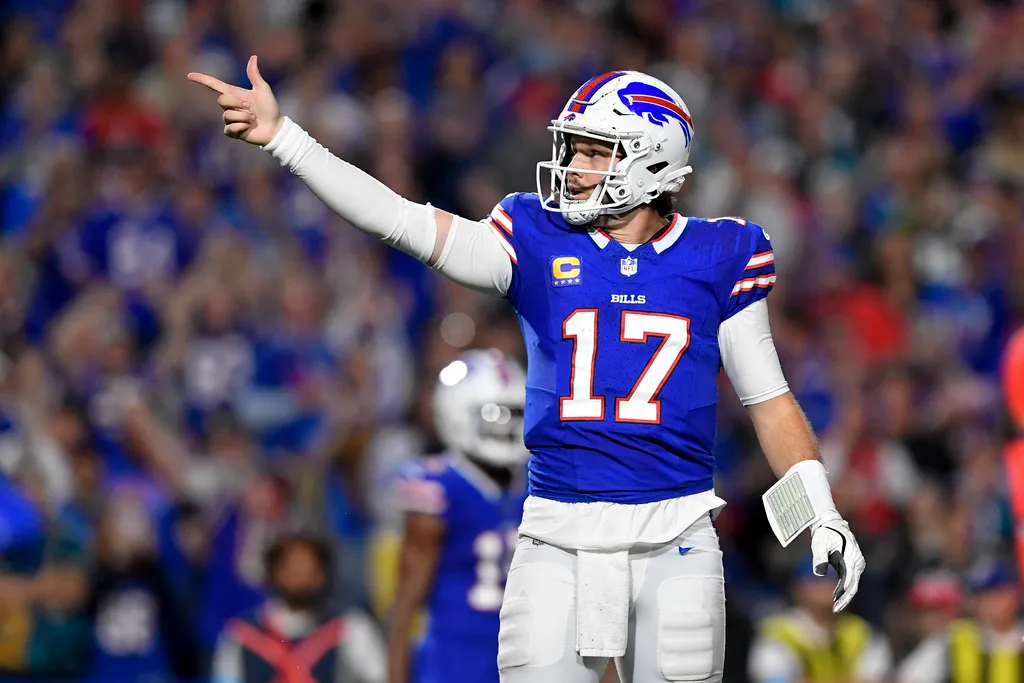
1. Josh Allen, Buffalo Bills
Allen is in a class by himself. He’s the only quarterback to finish among the top three in fantasy points per game in each of the last five seasons, and he hasn’t missed a start in that span. The receiving corps still isn’t elite even after adding DJ Moore, but that was true last year too when he finished as the position’s top scorer.
2. Lamar Jackson, Baltimore Ravens
Jackson isn’t as safe a bet as Allen after an injury-plagued 2025, and he’s adjusting to a new head coach and offensive coordinator. But the two-time MVP’s ceiling is still the highest at the position when healthy, and his price should reflect that risk rather than erase the upside.
3. Drake Maye, New England Patriots
Only Allen outscored Maye among fantasy quarterbacks in 2025, and the Patriots didn’t stand pat — they added A.J. Brown and Romeo Doubs to a receiving corps that’s now genuinely dangerous. The “sophomore slump for a Super Bowl loser” narrative doesn’t hold up against the actual weapons upgrade.
4. Joe Burrow, Cincinnati Bengals
When healthy, Burrow is a top-five fantasy quarterback — the problem is that’s only happened once in the last three years. The offseason buzz out of Cincinnati has been positive, but the injury history keeps him just outside the true elite tier.
5. Caleb Williams, Chicago Bears
Williams tied for eighth among quarterbacks in fantasy points per game in Year 1 under Ben Johnson, and a second season inside that offense brings real breakout equity. It’s a bet on continued development rather than a finished product, but the trajectory is squarely pointing up.
6. Jalen Hurts, Philadelphia Eagles
Hurts has finished among the top seven fantasy quarterbacks in five straight seasons and remains automatic near the goal line. A revamped receiving corps adds some uncertainty, and last year’s late-season dip is worth remembering, but the floor here is still one of the safest in the format.
7. Jayden Daniels, Washington Commanders
Daniels is electric when healthy and has genuine MVP-level equity, but Washington didn’t upgrade his supporting cast as much as many expected this offseason. He carries some of the highest variance of any quarterback in the top ten.
8. Dak Prescott, Dallas Cowboys
Prescott tied for eighth in fantasy points per game a year ago, and Dallas is returning largely the same offensive system and personnel. It’s a projection built on continuity rather than a leap.
9. Brock Purdy, San Francisco 49ers
Purdy has finished top-10 at the position in three straight seasons, including fifth in 2025 despite missing eight games. Adding a future Hall of Famer in Mike Evans to the receiving room only raises the ceiling further.
10. Trevor Lawrence, Jacksonville Jaguars
Year one of the Liam Coen–Lawrence partnership was encouraging even if Jacksonville’s offseason didn’t generate much buzz. A modest step back is possible, but so is another step forward — either way, top-10 production is squarely in range.
11. Justin Herbert, Los Angeles Chargers
Mike McDaniel’s arrival should help the offense as a whole, but his scheme tends to lean on quick, short throws that put more of the burden on receivers after the catch — which may cap rather than unlock Herbert’s fantasy ceiling. He hasn’t finished better than 10th at the position since his 5,000-yard 2021 season.
12. Matthew Stafford, Los Angeles Rams
The reigning real-life MVP has only finished top-10 in fantasy points per game once since joining the Rams in 2021, and he’s entering his age-38 season. Some regression toward that career norm should be expected even in a strong offense.
13. Jaxson Dart, New York Giants
Dart produced at a high level as a rookie even without Malik Nabers healthy, and an improved offensive line — highlighted by first-round tackle Francis Mauigoa — should help further. Nabers’ recovery timeline is the swing factor, but the rushing upside gives Dart a path to top-10 numbers.
14. Patrick Mahomes, Kansas City Chiefs
Mahomes is working back from an ACL tear, and it’s unclear exactly when he’ll be at full strength even if he’s active for Week 1. That uncertainty is enough to knock him out of the top tier for now, even accounting for his track record.
15. Bo Nix, Denver Broncos
As long as the surgically repaired ankle holds up, Nix should be no worse than a low-end fantasy QB1, with real upside if he takes another developmental step in Year 3.
16. Jared Goff, Detroit Lions
Goff has one of the best supporting casts in football — Amon-Ra St. Brown, Jameson Williams, Jahmyr Gibbs and Sam LaPorta among them — but he’s only cracked the top 10 at the position once in five seasons in Detroit. A well-protected Goff has real top-10 upside.
17. Kyler Murray, Minnesota Vikings
Murray has genuine league-winner potential if Kevin O’Connell’s offense unlocks him the way it has other quarterbacks, but that’s a significant if given his recent inconsistency.
18. Jordan Love, Green Bay Packers
Between questions about Josh Jacobs’ status and the depth and durability of Green Bay’s receiving corps and offensive line, there’s more uncertainty here than the name value suggests.
19. Baker Mayfield, Tampa Bay Buccaneers
Mayfield opened last season at a torrid, Allen-like pace before falling off dramatically — 14.2 fantasy points per game over the back half. Post-Mike Evans, a return to true QB1 form looks like a stretch.
20. Sam Darnold, Seattle Seahawks
Darnold is a proven real-football winner, but he averaged just 14.7 fantasy points per game last season — 26th among quarterbacks. With Brian Fleury replacing Klint Kubiak at offensive coordinator and no major identity shift expected, consistent fantasy QB1 production looks unlikely.
The bigger picture
The gap between Allen at No. 1 and the tightly bunched group from roughly No. 8 through No. 20 is enormous, which is exactly why “wait on QB” remains a viable strategy in single-quarterback leagues. If you miss the top two or three, there’s a strong case for grabbing two mid-tier arms — a Lawrence-Herbert pairing, for instance — rather than reaching early for a name that carries just as much risk as the players available several rounds later.
See today's NFL lines on DFS Lines, each one set against the player's last ten games.